
In short: Solar parks are usually maintained once or twice a year – so that vegetation does not shade the modules, the fire risk drops and maintenance crews can get through safely. Which method fits depends on the terrain, module height and the site’s nature conservation requirements.
Updated on 29.09.2026
Why vegetation management is needed in a solar park
- Protect yield: Tall growth shades the lower module rows and reduces power output.
- Fire protection: Dry, tall grass increases the fire risk on site.
- Access for maintenance: Inverters, cable routes and modules must remain accessible for inspections.
Vegetation management is a significant cost factor: according to project developer JUWI, it can account for up to 50 % of the operations management fee (source: JUWI, 01.12.2025).
Methods compared
| Method | Suitable for | Limitations |
|---|---|---|
| Tractor or ride-on mower | large, flat sites with wide rows | cannot operate on slopes or under low modules |
| Brush cutter (manual) | edges, posts, small leftover areas | labour-intensive, physically demanding |
| Sheep grazing | larger sites with fencing, water and sufficient module height | follow-up mowing often needed, high coordination effort |
| Robotic mower | flat, well-prepared areas | limited on slopes, tall growth and uneven ground |
| Remote-controlled crawler mower | slopes, low module rows, dense growth | mulches – removing cuttings requires additional equipment |
When and how often to mow?
In practice, sites are mown once or twice a year, and three times on vigorous sites. If the plant is meant to promote biodiversity, the Austrian guideline “Ground-mounted PV plants and biodiversity” recommends:
- mowing once, at most twice a year
- the first cut from the second half of June at the earliest
- mowing in sections (staggered mowing) so that animals can retreat
- a cutting height of at least 10 cm
Source: Guideline on ground-mounted PV and biodiversity, im-plan-tat, 2022. What is binding is your plant’s permit or maintenance plan.
Mulch or remove the cuttings?
Mulching shreds the cuttings and leaves them on the ground. It is fast, needs no removal and prevents material from being thrown against the modules. However, the nutrients stay on the site – which tends to favour grasses over flowering plants.
For species-rich, nutrient-poor meadows, nature conservation guidelines therefore recommend removing the cuttings. Our advice: clarify in advance what your maintenance plan requires. Where mulching is allowed, a crawler mower is the most efficient solution; where removal is required, a different method or a combination is needed.
Sheep in the solar park
Sheep grazing is considered a near-natural alternative, but it has requirements. The Bavarian State Research Center for Agriculture lists, among others:
- a lower module edge of at least 80 cm
- a secure perimeter fence and permanent access to drinking water
- no loose hanging cables
- often a timely follow-up mowing, because sheep do not eat all plants
Source: LfL Bavaria, grazing PV plants with sheep, 2019. A compact crawler mower is well suited for the follow-up mowing between the rows.
Solar parks on slopes and between narrow rows
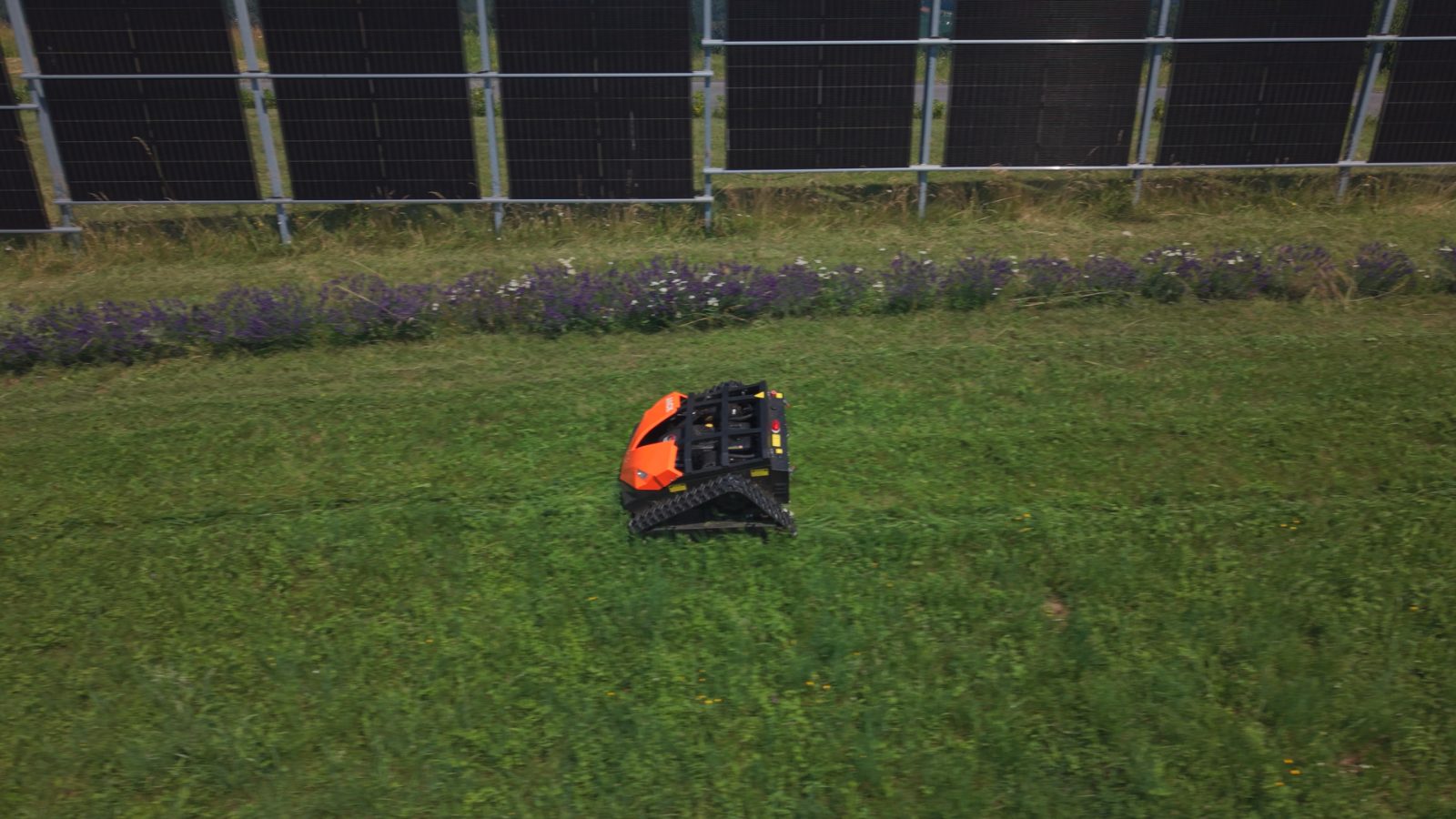
Many plants in the Alps are located on slopes – where tractors and ride-on mowers cannot go. A remote-controlled crawler mower works on gradients of up to 100 %, while the operator steers by radio from the edge of the site. The JACK Mulcher offers:
- 76 cm height for work under elevated modules
- 27 hp hybrid drive and up to 4,000 m² of area output per hour
- Cutting height 10–150 mm, including the recommended 10 cm
- Mulching deck instead of side discharge and chain guard curtain against ejected material
- Radio range up to 200 m with emergency stop and shutdown if the connection is lost
For narrow rows there is the JACK Mini, 61 cm high and 120 cm wide. You will find all details on use in solar parks on our page mowing solar parks with a crawler mower.
What does solar park maintenance cost?
Flat prices per hectare say little, because costs depend heavily on the site. The main factors:
- size of the area and number of cuts per year
- terrain: flat or sloped, ground conditions
- module height, row spacing and obstacles
- requirements: mulching allowed or removal needed
- travel and job planning
We are happy to calculate for your site whether your own machine pays off or a mowing service is cheaper. Prices for the JACK Mulcher and the mowing service are available on request. Our crawler mower comparison gives an overview of all models.
Frequently asked questions
Usually once or twice a year. On nutrient-rich or moist sites a third cut may be needed; where biodiversity requirements apply, often no more than two cuts are allowed.
Operators often mow in late spring and midsummer. Nature conservation guidelines recommend the first cut from the second half of June at the earliest. What counts is what your maintenance plan or permit specifies.
It depends on the requirements. Mulching is fast and needs no removal. Where biodiversity is to be promoted, removing the cuttings is usually recommended. Check your maintenance plan in advance.
No. The lower edge of the modules should be at least 80 cm high, and fencing, water and protected cables are required. A follow-up mowing is often needed as well.
The risk can be reduced significantly: the JACK Mulcher works with a mulching deck instead of side discharge, a chain guard curtain holds back material, and the operator steers with a clear view from a safe distance. Distances to modules and cables should be defined before the job.
Our mowing service is available in Styria, Carinthia and Burgenland. In Germany, Switzerland and Hungary, we will gladly put you in touch with one of our dealers for demonstrations and purchase.
Conclusion
Good solar park maintenance protects yield, equipment and biodiversity at the same time. What matters is the right method for the terrain and module height, the right timing and a look at the requirements. For slopes and low module rows, the remote-controlled crawler mower is often the most economical solution – as it is for embankments, see walk-behind mower or crawler mower?.
See JACK in your solar park
- In Austria, a free demonstration directly on your site
- In Germany, Switzerland and Hungary via our dealers
- Advice on purchase, rental or mowing service