
In short: A remote-controlled crawler mower takes people off the slope. The operator controls the machine by radio from up to 200 m away while it mows gradients of up to 100 % (45°). A walk-behind mower still makes sense when forage is to be harvested, the area is small or it is mown only rarely.
Updated on 29.09.2026
Where the walk-behind mower reaches its limits on steep slopes
Walk-behind mowers with double-knife cutter bars from brands such as Brielmaier, Aebi, Reform or Rapid have shaped slope management in the Alps for decades. They are robust, comparatively affordable and proven for forage harvesting. On steep slopes, however, the principle has one constant: the operator walks along.
- The operator stands on the slope. In wet conditions, on loose soil or around obstacles there is a risk of slipping and falling – in the worst case together with the machine.
- High physical strain. Guiding, holding against the slope and turning are hard work, especially over several hours.
- Vibration and noise. Hand-arm vibration from the handlebars is recognised in occupational medicine as a strain on hands, arms and joints.
- Weather and soil set the schedule. If the slope is too wet, working on it is often not justifiable – and the vegetation keeps growing.
- Staff are getting scarcer. Experienced slope mowers are hard to find for many farms and municipalities.

What is a remote-controlled crawler mower?
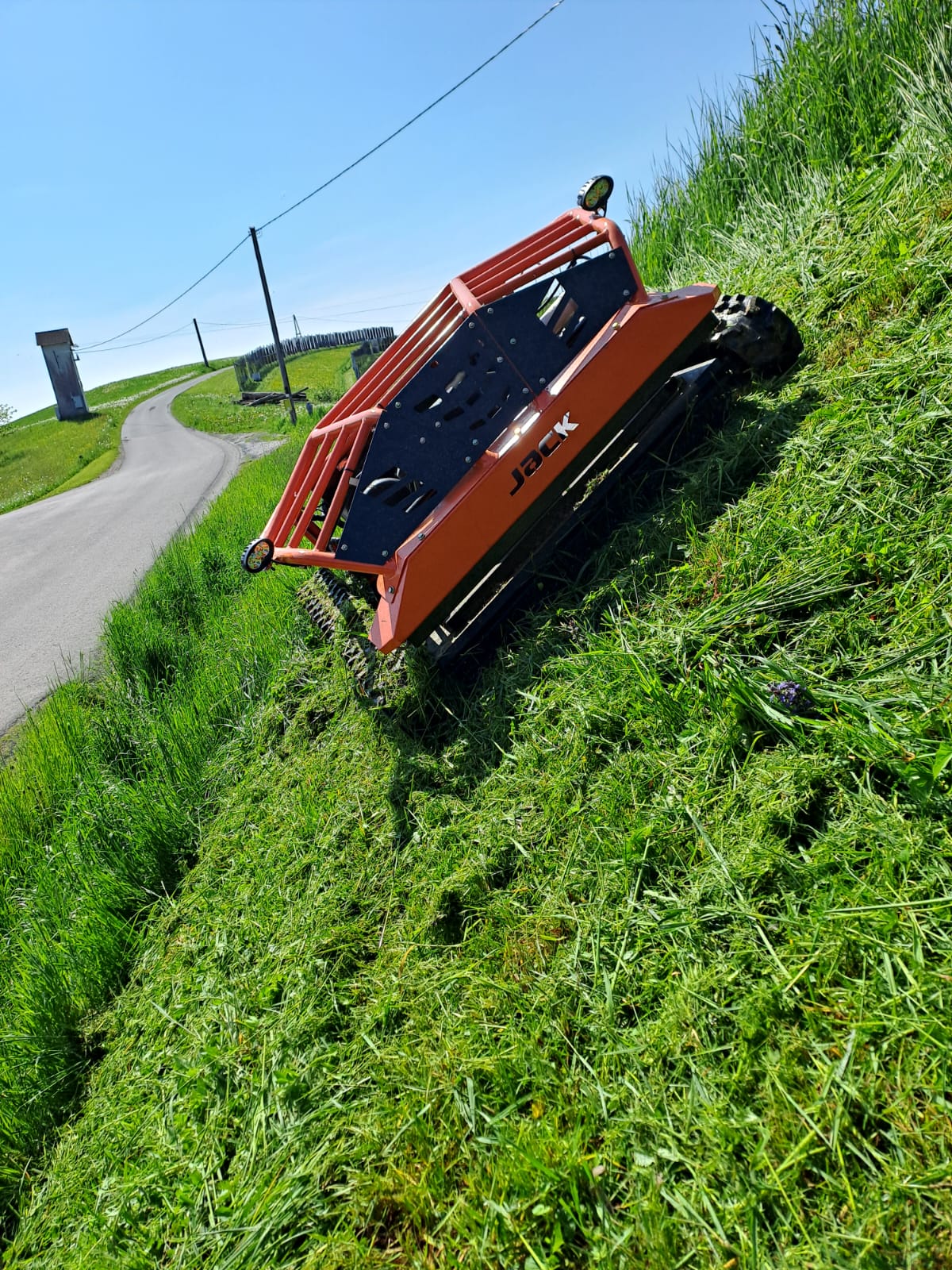
A crawler mower is a tracked mowing machine controlled by radio remote control. The operator stays at the roadside, on top of the embankment or in another safe position. The JACK Mulcher and JACK Schlegel work on gradients of up to 100 % (45°), with a radio range of up to 200 m and an area output of up to 4,000 m² per hour.
- Tracks with steel reinforcement for grip even on damp ground.
- Emergency stop on the transmitter and automatic shutdown if the connection is lost.
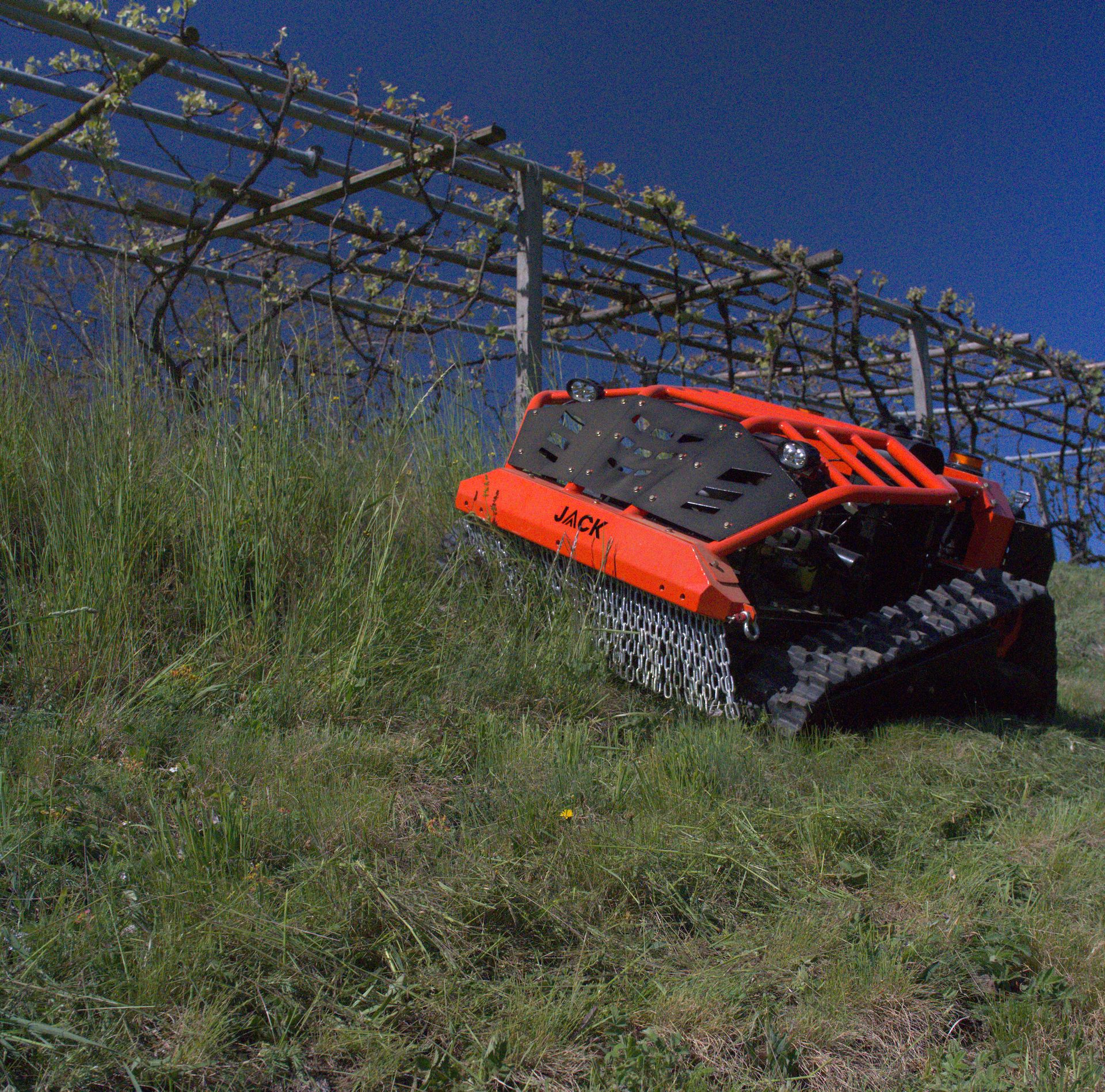
- Chain guard curtain against ejected material (JACK Mulcher and JACK Schlegel).
- Mulching instead of cutting: the cuttings are shredded and remain on the ground as mulch.
Walk-behind mower and crawler mower compared
| Criterion | Walk-behind mower (single-axle, cutter bar) | Remote-controlled crawler mower (e.g. JACK) |
|---|---|---|
| Operator position | walks on the slope | up to 200 m away, off the slope |
| Physical strain | high | low |
| Hand-arm vibration | yes, from the handlebars | none for the operator |
| Gradient | depends on model, tyres and operator | up to 100 % (45°) |
| Area output | depends on cutter bar width and terrain | up to 4,000 m²/h (JACK Mini: up to 2,000 m²/h) |
| Cuttings | cut, suitable for forage harvesting | mulched and left on the ground |
| Use in wet conditions | often limited | steel-reinforced tracks for more traction |
| Purchase | usually cheaper | higher, price on request |
Bottom line: the walk-behind mower usually wins on purchase price. Once staff hours, downtime and the risk to the operator are factored in, the picture shifts – especially for areas that need regular maintenance. Our crawler mower comparison shows how the models rank in the market.
5 reasons to switch to a crawler mower
1. People stay out of the danger zone
Accidents with walk-behind mowers on slopes keep happening in agriculture and forestry. With a crawler mower, the operator does not stand on the slope but steers from a safe distance. For municipalities, maintenance depots, energy suppliers and their insurers, this is often the key argument.
2. Gradients up to 100 % – even on damp ground
Steel-reinforced tracks provide grip where wheels and boots slip. Maintenance dates therefore depend less on the weather.
3. Less working time and fewer staff per job
With up to 4,000 m² per hour and just one person at the remote control, many areas can be maintained faster than with a walk-behind mower or brush cutter. How much time you actually save depends on the area, vegetation and terrain – we are happy to estimate this from photos of your site.
4. Much lower physical strain
No holding against the slope, no vibration in your hands. This relieves older operators and makes the work more attractive for the next generation.
5. One machine for many applications
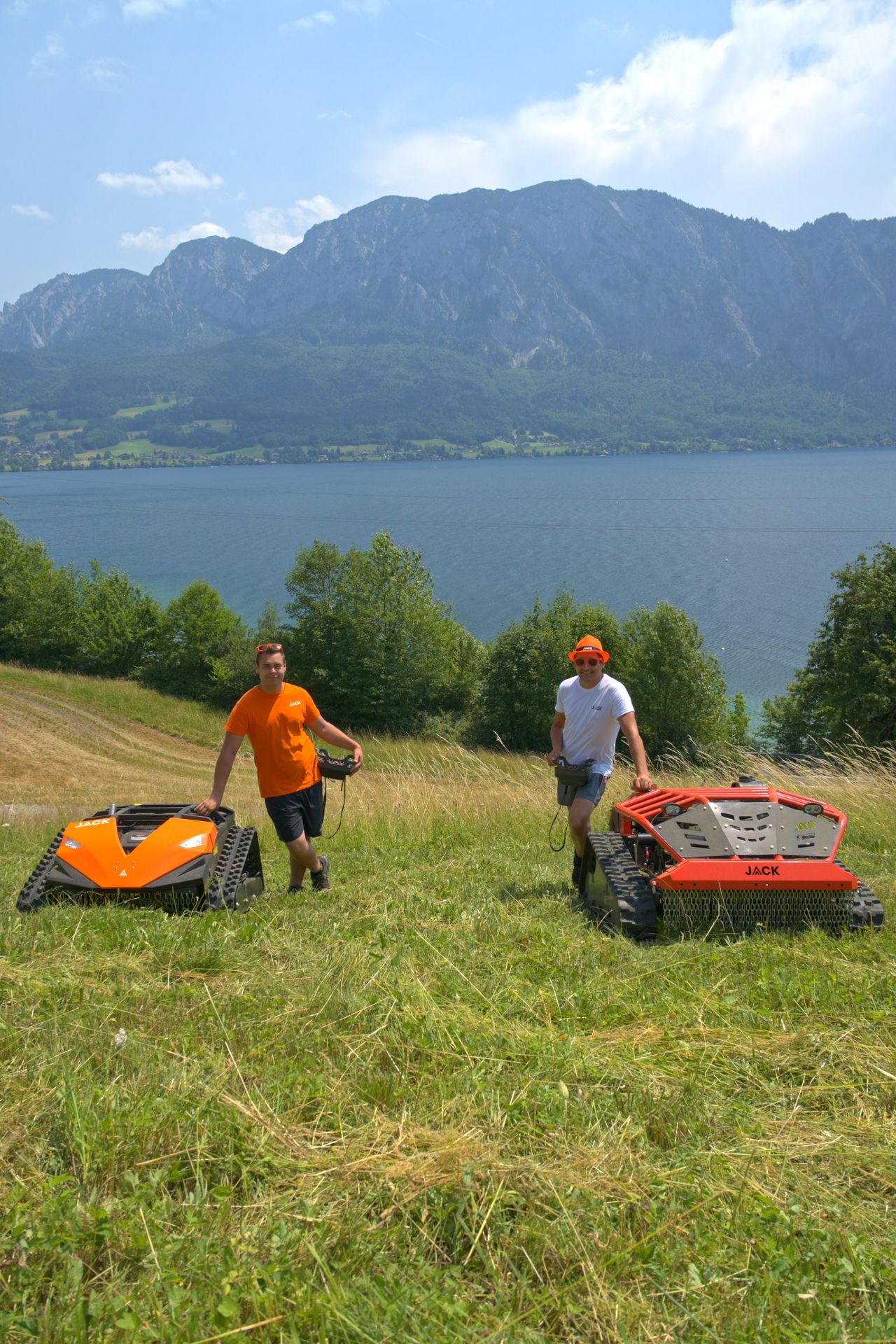
With a height of only 76 cm, the JACK Mulcher drives under elevated photovoltaic modules. The JACK Schlegel with flail rotor and Y-blades is built for denser growth. At 61 cm high and 120 cm wide, the JACK Mini is the most compact model for narrow rows and smaller areas. Learn more under applications: solar parks, steep vineyards and alpine pastures.
When a walk-behind mower is still the better choice
To be honest: a crawler mower does not replace every walk-behind mower.
- Forage harvesting: If you want to make hay or silage, you need a cut with a cutter bar. A crawler mower mulches – the cuttings stay shredded on the ground.
- Small areas that are mown only a few times a year.
- Very tight spots where even the JACK Mini (120 cm wide) does not fit.
- Very rare use where neither buying nor a mowing service pays off.
- An existing machine that will do for occasional maintenance for many years.
For regular embankment care, alpine pastures, solar parks, steep vineyards, municipal green spaces or landfills, however, the crawler mower is usually the better tool.
Which JACK model suits your site?
| Feature | JACK Mini | JACK Mulcher | JACK Schlegel |
|---|---|---|---|
| Engine | 13 hp, single cylinder | 27 hp hybrid, Briggs & Stratton | 23 hp, Briggs & Stratton, 2 cylinders |
| Cutting unit | mulching deck, 65 cm cutting width | mulching deck | flail rotor with Y-blades |
| Max. gradient | up to 100 % | up to 100 % (45°) | up to 100 % (45°) |
| Area output | up to 2,000 m²/h | up to 4,000 m²/h | up to 4,000 m²/h |
| Cutting height | 30–100 mm | 10–150 mm | 10–150 mm |
| Dimensions (L × W × H) | 100 × 120 × 61 cm | 158 × 131 × 76 cm | 164 × 136 × 85 cm |
| Weight | 295 kg | 440 kg | 530 kg |
| Typical use | smaller areas, narrow rows | embankments, solar parks, vineyards | dense, vigorous growth |
Data taken from the product pages. Prices are available on request – depending on model and equipment.
Buy or use a mowing service?
Owning a machine usually pays off with:
- regular use throughout the season
- your own staff to operate the machine
- the option to offer maintenance services to others
A mowing service is a better fit with:
- seasonal or occasional needs
- no staff or no slope experience
- a wish for predictable costs without investment
JACK Works offers both: sales of the JACK Mini, JACK Mulcher and JACK Schlegel, and a mowing service with operator, transport, fuel and machine maintenance in Styria, Carinthia and Burgenland.
Are there subsidies for a crawler mower?
In Austria, the main option is the investment subsidy for agricultural holdings (measure 73-01, funding period 2023–2027). In Styria, for example, self-propelled special machines for mountain farming receive a 20 % investment grant. Requirements include a holding in a mountain or less-favoured area or with steep land over 25 % gradient, and net costs of at least EUR 15,000 (Source: AMA, as of 29.09.2026).
Whether a remote-controlled crawler mower is accepted in an individual case is decided by the funding authority – ideally clarify this in advance with your chamber of agriculture. ÖPUL payments for mowing steep land are area payments, not a subsidy for buying a machine. Germany and Switzerland have their own funding programmes.
Frequently asked questions
The price depends on the model and equipment. You can get a non-binding quote for the JACK Mini, JACK Mulcher or JACK Schlegel on request. If you do not want to buy a machine, you can book our mowing service in Austria.
JACK models work on gradients of up to 100 %, which equals 45°. Soil and vegetation also matter – during a demonstration we check this directly on your site.
No. A crawler mower mulches: the cuttings are shredded and remain on the ground. For hay or silage, a cutter bar remains the right technology.
The JACK Mulcher and JACK Schlegel have a radio range of up to 200 m. If the connection is lost, the machine switches off automatically. There is also an emergency stop on the transmitter.
In Austria, the investment subsidy 73-01 for special mountain-farming machines may apply. Whether a crawler mower is accepted in an individual case is decided by the funding authority or your chamber of agriculture. See the section on subsidies above for details.
Yes. In Styria, Carinthia and Burgenland, JACK Works takes care of your land with machine and operator – learn more about our mowing service.
In Austria, we demonstrate the JACK models free of charge and without obligation directly on your site. In Germany, Switzerland and Hungary, we will gladly put you in touch with one of our dealers. Request a demonstration.
Conclusion
The walk-behind mower has carried slope management for generations and remains useful for forage harvesting and small areas. Where land needs regular maintenance, staff are scarce and operator safety matters, the remote-controlled crawler mower is today the up-to-date solution.
See JACK on your own site
See for yourself how a crawler mower handles your embankment, pasture, solar park or vineyard – and try the radio remote control yourself.
- In Austria free of charge and without obligation, on site
- In Germany, Switzerland and Hungary via our dealers
- With honest advice on model choice, purchase or mowing service